LR
From problem to working AI solution

I build what others staff a team for.

I break down your problem, decide where AI helps and where plain code is enough, build the first version myself and measure whether it holds up.

Lukas Ripota
EarlyGame, 2024

My team asked whether I was secretly paying freelancers on Fiverr. I wasn't. I had automated the research.

973 studios researched automatically1,881 contacts found6 email variants tested9,200 lines of my own coding agent6,600 lines of voice assistant188 of 189 fields read correctly973 studios researched automatically1,881 contacts found6 email variants tested9,200 lines of my own coding agent6,600 lines of voice assistant188 of 189 fields read correctly
01Projects

Three problems. Every company has them.

Chosen by research. According to MIT, back office delivers the highest return. 72% of German companies that use AI deploy it in customer contact (Bitkom 2026). And retirements take knowledge that was never written down.

01Live demo

Invoice intake with matching

The problem

Invoices arrive as PDFs, scans, phone photos, receipts or e-invoices, and every one looks different. Usually someone types them in, digs out the purchase order and delivery note and compares them line by line. Overbilled quantities, wrong prices and duplicate invoices often surface only after the money is gone.

$9.90is the average cost of processing one invoice. The best teams manage $2.67. Ardent Partners 2026, US
The solution

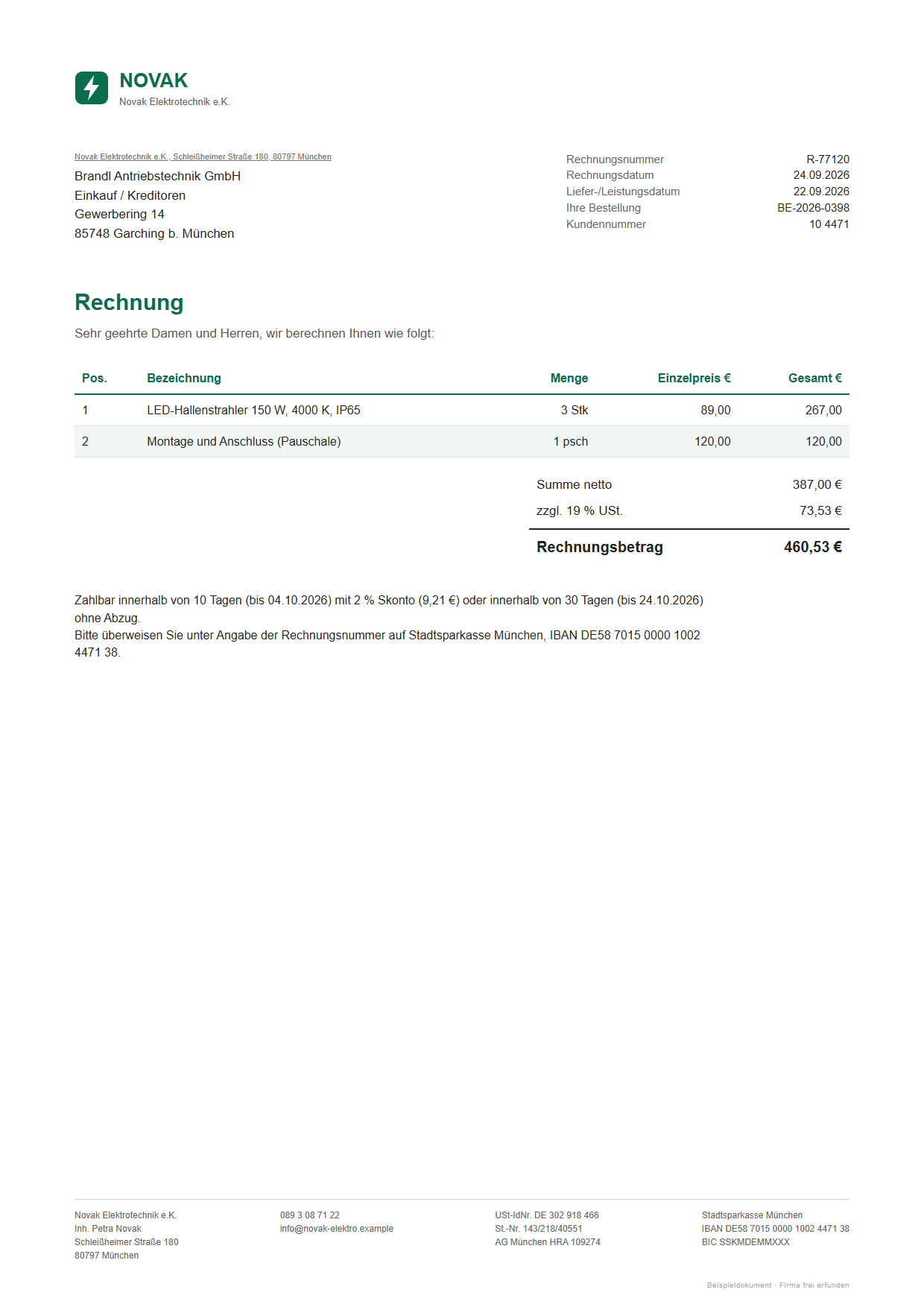
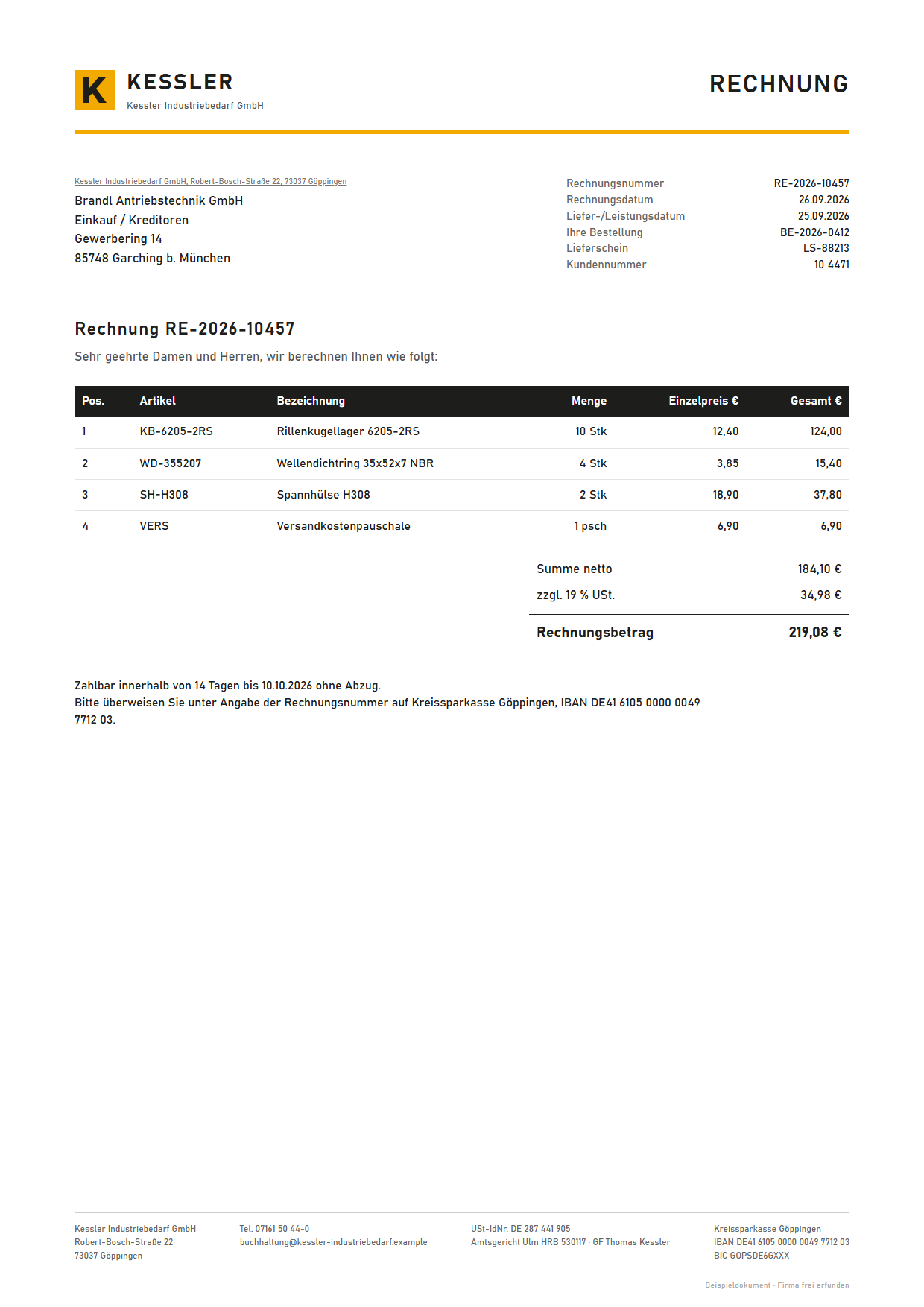
The model reads each document, code matches purchase order, delivery note and invoice. Every value shows where it sits in the original. E-invoices are parsed directly, no model needed. Nothing gets paid until a human approves it.

  • Gemini reads
  • 5.3 s per document
  • 0.48 US cents per document
  • 188 of 189 fields correct
Invoice
RE-2026-10457
PO
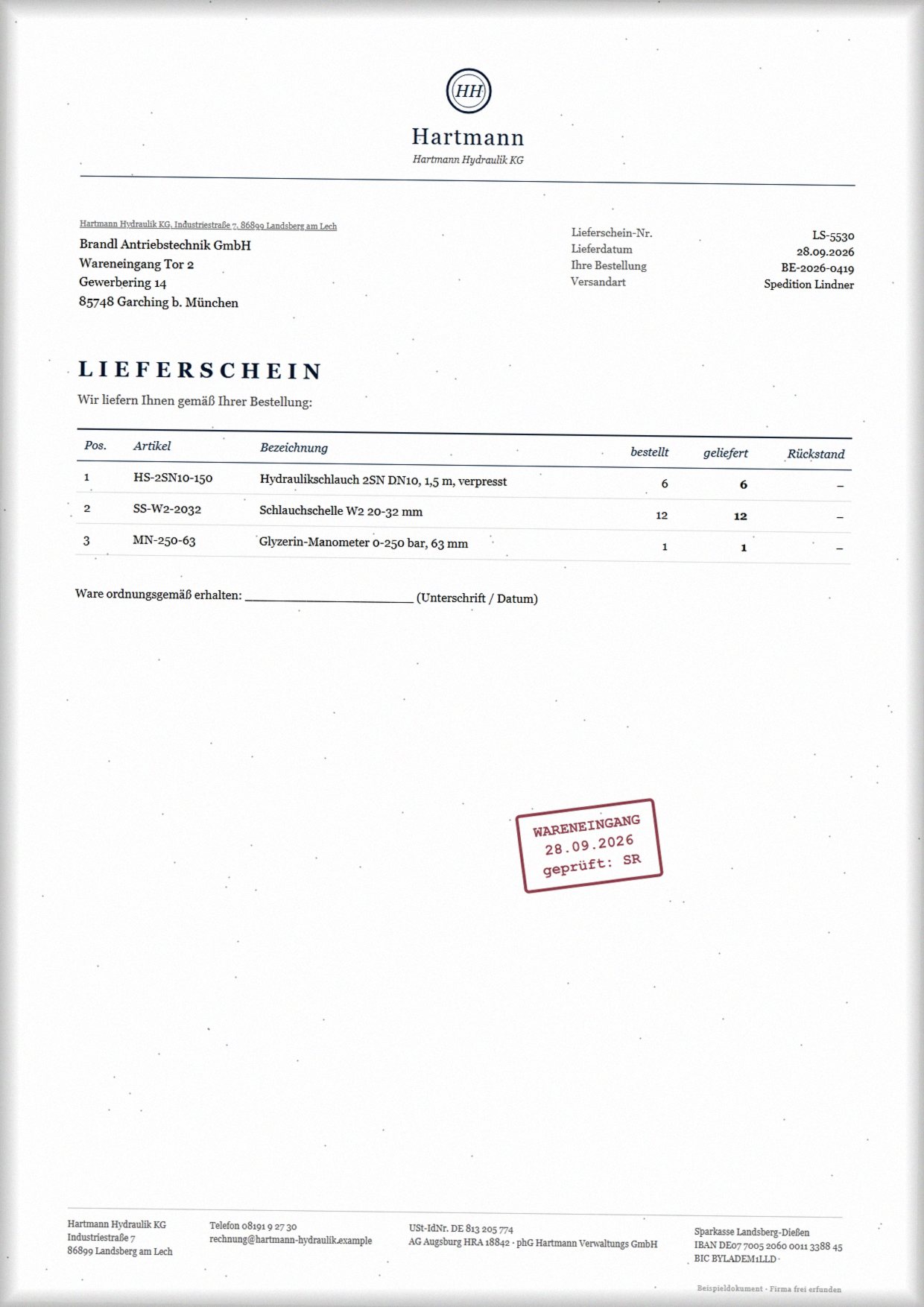
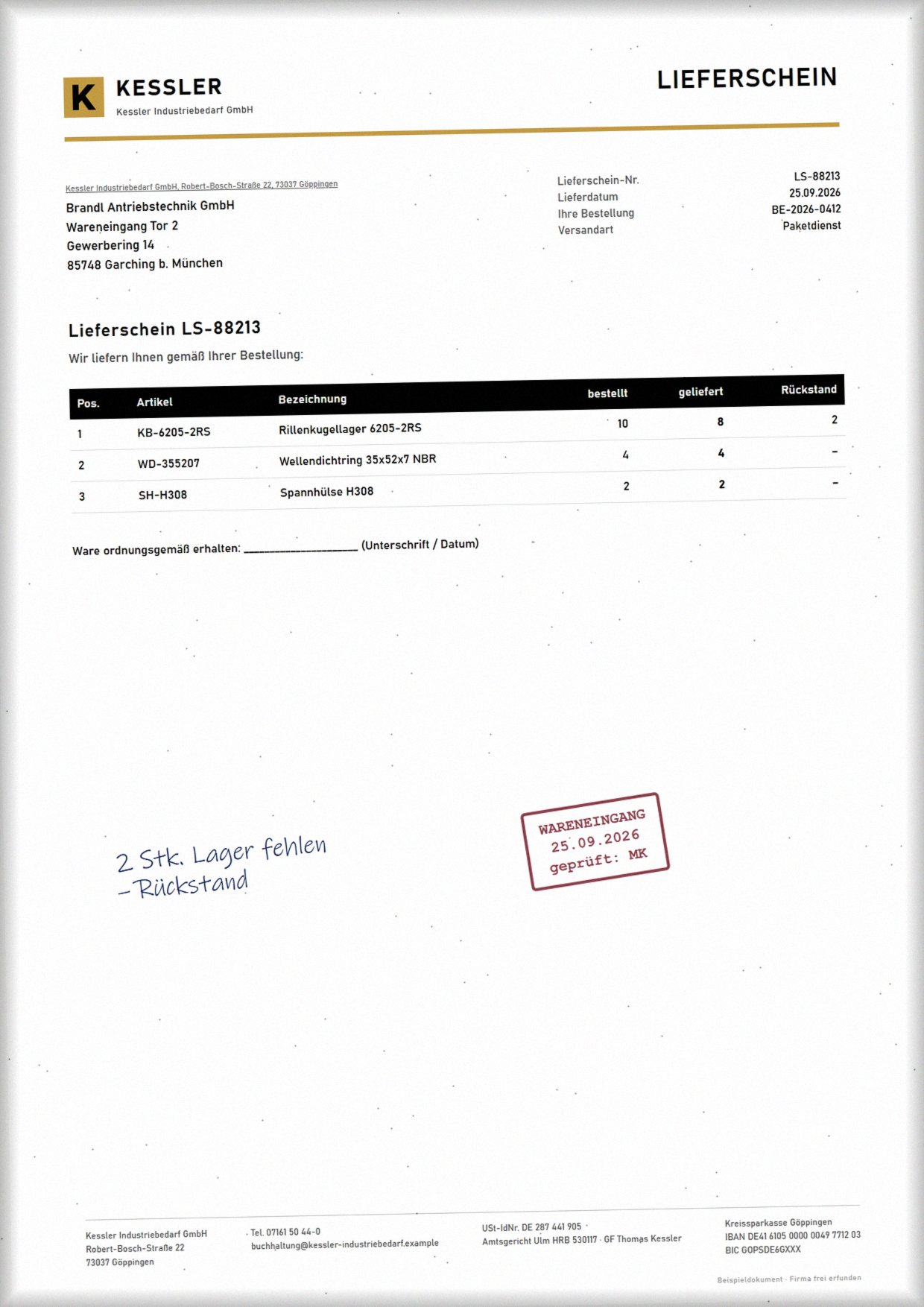
BE-2026-0412
Gross
219,08 €
10 invoiced · 8 delivered

02Live demo

Talk to my portfolio

The problem

Call a hotline and you often end up in a phone menu: “Press 1.” Chatbots go round in circles, no human is reachable, and the actual question stays open. For the company that means full queues and customers who give up.

50%of German online shoppers are satisfied with chatbots. With a human on the other end it's 86%. Bitkom 2025
The solution

A voice assistant that understands freely spoken questions and answers right away, around the clock. When it can't help, it hands over to a human with a summary, so nobody has to explain everything again. Here it talks about me, shows you around the site and takes messages for me. Give it a try.

  • Reply in about 1–2 s
  • 2–4.5 US cents per minute
  • says it is an AI
Gemini 3.8 Live · up to 5 minutes
Hi, I'm Friday, Lukas's personal AI assistant. I can tell you about him or show you his projects.
What did he do at EarlyGame?
One moment, let me check. He automated the studio research there with his first AI scripts. Shall I show you where it is?
Tools
Looked up: EarlyGameShowing: Background
Reply usually starts after1 to 2 s
■ Listen■ Think■ Speak
03Live demo

Capture know-how before it retires

The problem

Who is irreplaceable, and what does that cost? The most important knowledge isn't in any manual. It's in the head of the maintenance technician who retires soon. At night the shift waits until he picks up the phone.

13.3mpeople in Germany's workforce reach retirement age in the next 15 years, 30% of the 2025 total. Destatis, June 2026
The solution

Code counts from the fault tickets in milliseconds who knowledge depends on and how much downtime that has already cost. Only that is what the foreman gets asked, about patterns rather than dates. The lead approves, and the ticket gets the answer with its source.

  • 9 of 12 breakdowns solved
  • 0 of 30 confidently wrong
Knowledge check62 fault tickets · no AI
JH
Josef Hainz
Maintenance foreman · retires in 6 months
14
faults, only he was called
45 h
downtime on them
37 h
waited overnight for him
  • K-2Overtemp. shutdown7×
  • P-204Rattles on start-up3×
  • HA-1Inductor overcurrent2×
When P-204 acts up, HA-1 reports within 2 h too (3×). Not written down.
04Your project

I picked three projects. You pick the fourth.

Want to see how I work before you hire me? Give me a real task from your day-to-day. I break it down, build a first version and show openly what the AI can do and where it fails.

  1. 1You describe the task. A few sentences are enough.
  2. 2I get back to you with a plan, the effort and my questions.
  3. 3I build the first version and send you the link.
Ideas to pick from

Your details go only to me and are only used to reply. More in the privacy policy.

02Approach

Analyse it. Build it. Measure it. Only then does it go live.

1/4

Analyse

Which process eats the most time? Where does AI help, where is plain code enough? Which model fits, and what does one run cost?

2/4

Build

I build the prototype myself, with coding agents. I know how they work from the inside: I built one myself.

3/4

Measure

How accurate, how fast, how expensive? Measured on test data with known answers. I show the score, even when it isn't 100%.

4/4

Operate

Who signs off? What may the agent do alone? Who notices when something goes wrong? Only then is it done.

Lukas RipotaFrom problem to working AI solution

AI writes most of the code. I decide what gets built, how it's tested and when it's good enough. That is the job.

Under the hood

Built myself. To understand what I work with.

In spring 2026 the big vendors' agents could do far less than today. So I built the missing parts myself. I shelved LukeCode and Jarvis once the vendors caught up. What I learned doing it, I use every day.

LukeCode

~9,200 linesShelved

My own harness for coding agents in the terminal: the layer between model and machine that calls tools, manages context and counts cost. Built in May 2026.

Shelved once the big vendors caught up. The understanding stayed.

The problems I had to solve

  • Context rot

    The fuller the context, the more forgetful and expensive the model. LukeCode cuts tool results down to one line after each finished turn, reads files in 200-line windows and shows how full the context is.

  • Tool loop

    Up to 12 rounds per task, then the harness forces an answer. Broken tool calls go back to the model as an error message instead of crashing everything. Escape cancels cleanly.

  • Researching properly

    Five search engines as a fallback chain, up to four query variants at once, docs and official sources ranked above social media. From the top three pages only the relevant passages enter the context. For current topics it adds the year to the query.

  • Every provider is different

    DeepSeek wants its reasoning sent back, Fireworks needs a cache key, OpenRouter serves prices live. The harness evens that out and prices every message, even when the model changes mid-session.

  • Computer controlPlanned, not built

    Not every model operates a screen equally well. Specialised models like H Company's Holo led the benchmarks. I worked out how to attach one to the harness as eyes and hands. I never built it, the big agents caught up.

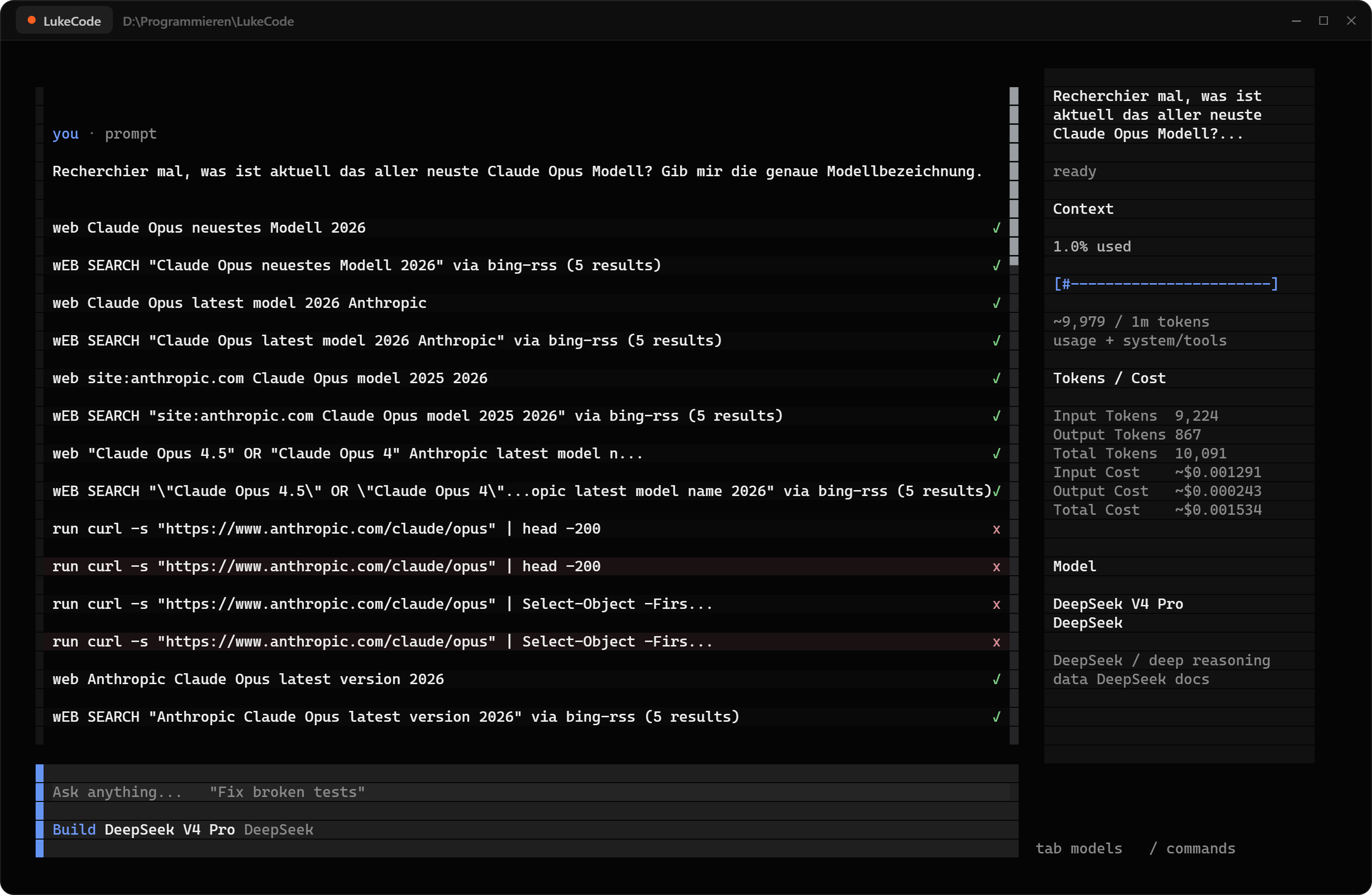
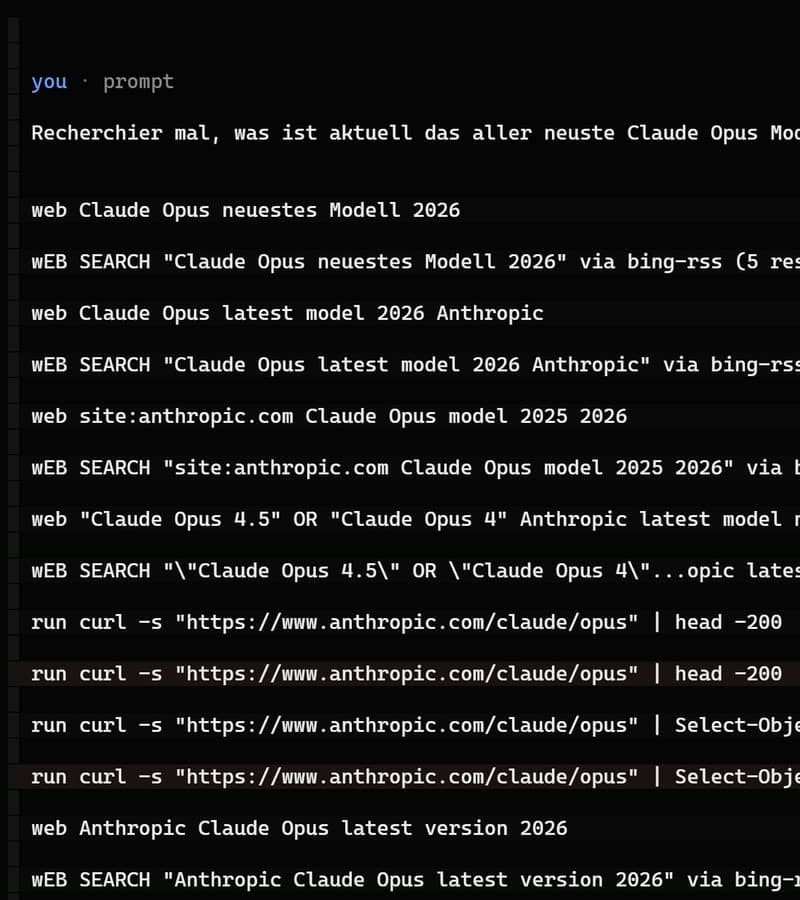
LukeCode in the terminal: a research task with twelve tool calls, context and session cost on the right
A real session from 31 May 2026. One question, twelve tool calls: search runs through the fallback chain (Bing RSS here), failed shell commands go back to the model as errors. On the right: 1.0 % of context used. The cost display (0.15 US cents) only counts the final model round so far, the session cost more.

Jarvis

~6,600 linesShelved

Voice assistant for Windows, May 2026. The goal: as little waiting as possible between question and answer.

Built against waiting

  • Answers on a hunch: the model starts on the half-finished sentence. If the final sentence matches, the answer stays.
  • Speaks while it's still writing: the voice gets text as soon as the first half-sentence exists.
  • Can be interrupted: talking over it stops the reply without losing your first syllables.
  • If one provider hits its rate limit, the next takes over: Google, Fireworks, Groq.

Next ideas, not in the final version

  • Fast and smart at once: a fast model replies instantly, with a filler if needed. A strong one thinks in the background and follows up.
  • Dreaming: when nobody is talking, the agent reviews the history and sorts out what is worth remembering.
  • A memory that doesn't overflow: store thoughts so they can be found months later without stuffing every context with old knowledge. I built a first version and took it out again.

MCP servers

2 in use

MCP is the standard that lets AI agents plug in tools. Whatever my agents are missing, I add.

  • Video, audio, YouTube

    Claude can't watch videos or listen to audio. My server hands that to Gemini: YouTube, audio, PDFs. If one Gemini model is overloaded, the next one steps in.

  • local video model

    Codex generates videos locally through ComfyUI with the MiniMax H3 video model. Jobs run in the background, file paths and workflows are limited to an allow-list.

My models, as of October 2026
Builds

Claude Opus

The expensive worker. Writes code, plans, reviews. Runs in Claude Code, this site was made that way too.

Sees and hears

Gemini

Images, video, YouTube, audio. Through my MCP server for Opus too. Reads the documents in the invoice demo.

Cheap and fast

DeepSeek

For volume and comparisons. In the invoice test almost as accurate as Gemini and about ten times faster. A Chinese provider, so not for real customer data.

For testing

OpenRouter

Many models behind one interface, some of them free. That's how I try new models before committing.

What my agents write in. I read and review, I don't have to type it.

  • TypeScript
  • Python
  • Bun
  • Next.js
  • React
  • Tailwind CSS
  • GitHub

Design

  • BDEngine
  • Blender
03AI & Data

Does AI train on company data? The plan decides.

A cost calculation, quickly pasted into an AI chat because the quote has to go out today. Afterwards, there's an uneasy feeling. Does the model learn from it? Could the calculation turn up at a competitor? Who else can read it, and where is it stored now? And who on the team is doing the same thing?

45%

of German companies fear that company data ends up in the wrong hands through AI. In 2025 it was 39%.

Bitkom, September 2026
66%

of companies already using AI name data protection as a barrier. More than anything else.

Bitkom, September 2026
42%

of companies: staff use private AI tools at work, confirmed or suspected.

Bitkom, October 2025

Four ways to use AI. Where the data ends up.

Whether AI is safe with company data depends less on the model than on the route to it. The biggest risk is the private chat account, free or paid: chats there usually go into training by default, and there is no contract with the company. On business plans and paid APIs, training is off by default, and the contract says so. What remains there are retention periods and US law. Here are the four usual routes, from riskiest to safest, and what each is good for.

01Not for company data

Private chat account

For comparison: how it often happens today

On-site
EU
US
CompanyModel
Training
ExamplesChatGPTGemini app
Company dataends up in training
What happens

Someone pastes a contract or a customer email into ChatGPT or the Gemini app, using their private account, free or paid. Legally that is a contract between that person and the provider. The company isn't involved at all and usually never finds out.

Why it's risky

On consumer accounts, training is the norm. On ChatGPT Free, Plus and Pro and in the Gemini app, chats go into training by default, on Claude.ai if the setting is on. Once something is in the training data, it can't be pulled back out. In the Gemini app, human reviewers read along for quality control. Only each individual can switch this off, and the company can't see whether they did.

Good for

Private questions and public information. Never customer data, contracts or source code.

Training
yes, by default
Contract with the company
none
Data sits
mostly in the US
Residual risk
data in training
Cost
free or subscription
Good for
public info only

Gemini chats reviewed by humans are kept for up to 3 years, even after deletion. 34.8% of what staff paste into AI tools is sensitive, most often source code (Cyberhaven 2025).

02For most workflows

Paid API

Fastest start, best models

On-site
EU
US
CompanyModel
no training
ExamplesOpenAIClaudeGemini
Company dataends up in training
What happens

The company signs a business contract with the provider, including a data processing agreement (DPA). Its own software sends data straight to the model, with no chat window in between. That's how my invoice demo is built too.

How safe it is

No training: at OpenAI, Anthropic and the paid Gemini API it's off by default and guaranteed by contract. Data is still stored, for abuse monitoring, up to 30 days, 55 at Gemini. And it usually sits in the US, where authorities can demand access under the CLOUD Act.

Good for

Invoices, enquiries, internal texts, as long as the DPA and the Data Privacy Framework fit. Not for trade secrets.

Training
no, by contract
Contract with the company
DPA
Data sits
mostly in the US
Residual risk
US law, CLOUD Act
Cost
approx. 0.5 US cents per document
Good for
invoices, enquiries

Zero data retention is available on request at OpenAI, Anthropic and Vertex AI. My rule: paid access with a DPA only, never free tiers with real data.

03When data must stay in the EU

Cloud in the EU

Data centre in Europe

On-site
EU
US
CompanyModel, EUCLOUD Act
no training
ExamplesVertex AIAzureMistral
Company dataends up in training
What happens

The same large models, but booked in a European cloud region: Gemini via Vertex AI in Frankfurt, GPT via Azure with an EU data zone. Or a European provider like Mistral to begin with.

How safe it is

Processing stays in the EU, transfers to the US fall away, training is off. One thing remains: if the provider belongs to a US group, the CLOUD Act reaches data in Frankfurt too. In 2025 Microsoft could not rule that out under oath before the French Senate.

Good for

HR and customer data, when data protection requires all processing to happen in the EU.

Training
no
Contract with the company
DPA
Data sits
in the EU
Residual risk
CLOUD Act for US providers
Cost
similar to the API
Good for
HR and customer data

The regional endpoint is what counts: global endpoints don't guarantee processing in the EU. Mistral is an EU provider and hosts in the EU by default.

04For trade secrets

On-premise

Data never leaves the building

On-site
EU
US
Company
Model on-site
ExamplesQwen3-VLPaddleOCR
Company dataends up in training
What happens

An open model runs on a machine in the building. No provider sees the data, no connection to the outside is needed.

How safe it is

As secure as your own IT. The price: buy the hardware, maintain it yourself, and open models are usually weaker than the best cloud models. Whether that's enough for a task has to be measured, not guessed.

Good for

Designs, formulas, contracts, anything that must never leave the building.

Training
no
Contract with the company
not needed
Data sits
on-site
Residual risk
your own IT security
Cost
€1,500–5,000 hardware
Good for
designs, formulas, contracts

Small document models like PaddleOCR-VL fit on a 16 GB graphics card. The benchmark on my RTX 5070 Ti is coming.

The questions that always come up
What you need to know

AI Act, Art. 50

In force since 2 Aug 2026: anyone talking to an AI must be told at first contact at the latest, unless it is obvious.

Data Privacy Framework

Upheld by the EU General Court on 3 Sep 2025. The appeal at the CJEU (C-703/25 P) is pending, with no ruling yet. It applies, with residual risk.

Processing agreements

According to Germany's Data Protection Conference (DSK), AI as a cloud service is in principle processing on behalf of the controller: one DPA per provider under Art. 28 GDPR. Some free tiers train on inputs, so never use them with customer data.

High-risk AI

Postponed: stand-alone systems under Annex III to 2 Dec 2027, AI in products such as machinery (Annex I) to 2 Aug 2028.

Not legal advice. Based on the providers' terms as of October 2026.

04Side projects

Built because it's hard. Not because anyone asked.

On the side, I like building things that seem slightly out of reach. That's where I learn the most. They include my own harness for coding agents, a voice assistant and piano arrangements made with AI.

Most of it, though, happens in Minecraft. That's where it all started, and it's where every result shows instantly: the machine walks, or it doesn't.

Without mods there are only blocks, a few display entities and 50 milliseconds per server tick. Every movement is code. Within those limits I build machines that walk, climb and aim. It's the same work as on the job: break the problem down, measure, make it faster.

13

Where it started

First plugin at 13, later my own server with its own players. That's where the wish to study computer science came from. I taught myself to code.

0 mods

Why Minecraft

No mods, no resource pack: what players see is vanilla. The less the game offers, the cleaner the solution has to be.

Star Wars

Why Star Wars

Round, heavy machines in a world made of cubes. The contrast could hardly be bigger, and that's exactly the appeal.

The projects

Every card opens up.

01Design + plugin

AT-ST

A biped of 187 parts that plans every step on its own.

02Plugin · with AI agents

Droids

Six droid types with formations and a gunship, built in just over a week with AI agents.

03Plugin

FluidRealism

Finite water: nothing comes from nothing, nothing vanishes.

04Music · not Minecraft

AI piano

Piano versions of well-known songs, arranged by AI, signed off by me by ear.

05AI tool · not Minecraft

LukeCode

My own coding agent for the terminal, with web research and cost per message.

06Voice assistant · not Minecraft

Jarvis

My voice assistant for Windows that starts thinking before the question is over.

07Plugin · prototype
Clip coming

World generator

Realistic mountains with a ported erosion filter.

08Model
Clip coming

UH-1 Huey

A UH-1 Huey made of blocks.

05About
Lukas Ripota
Lukas Ripota
Munich · German, English

Quick to learn. Keener to build.

I'm Lukas from Munich. Fachabitur in business (university of applied sciences entrance qualification), one semester of computer science at Munich University of Applied Sciences. Too much theory, too little building. Then voluntary military service, and since April 2026 my own AI projects.

Background
How I got into AI

I was into AI before ChatGPT. Back then, just watching.

  1. GPT-3

    Interviews with a machine

    Before ChatGPT I watched video interviews with GPT-3 and argued in the comments about where it was heading. What I pictured back then: AI that does its own research and invents new technology.

    Interview with GPT-3
    HumanGPT-3
    Comments
  2. Late 2022

    ChatGPT in German class

    ChatGPT came out while I was sitting in German class. I started right away, experimented and began to code.

    New chat
    Send a message
  3. 2024

    First time on the job

    During my internship at EarlyGame, AI did real work for the first time: scripts for the studio research, still started by hand, step by step.

    Studio research
    Run script
    running
    Studios0
    Contacts0
    Email variants0

    Started by hand, step by step

  4. From 2024

    Coding in a chat window

    Then I started coding properly, in the regular ChatGPT and Gemini chat. Sending in classes as .txt files, having them analysed, talking them through with the models. That went on for quite a while.

    Chat
    ChatGPTGemini
    Class_A.txt
    Class_B.txt
    Attach a file
  5. 04/2026

    Agents and harnesses

    After the Bundeswehr I went all in and found my way to AI agents. First I wanted to understand: what actually is Claude Code? What is a harness? A few weeks later my own was running.

    Claude Code
    ›Build the matching against order and delivery note.
    Reads the project
    Plans the steps
    Changes the code
    Runs the tests
    ToolsContextCostHarness
    Context
    12 %
  6. Today

    Always up to date

    I keep up with the models: which one is the best right now? Which is the cheapest? What can it really do? That's exactly what decides what an automation costs later.

    Models compared
    QualityPriceSpeed
    Claude
    Gemini
    DeepSeek
    Mistral
    New modelnew
06Contact

Let's talk.

Full-time role or project: tell me what it's about. I usually reply the same day.